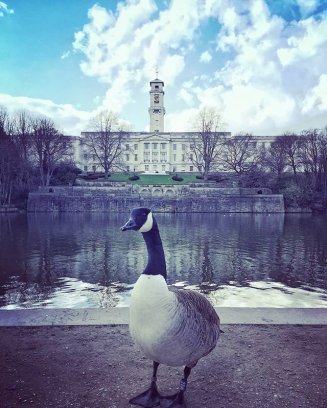
If I didn’t have a sense of obligation to promoting good science practises I’d be reiterating these words to every biology freshman I came across: don’t work with animals in the field. Wherever possible, don your white coat and stick an animal in a lab. That way, you get to stay indoors, in the warm, where it’s well lit. There’s no risk of your research animal running away, or just not being there. Alas, in science we don’t always have the luxury of comfortable research. And unfortunately for me in the case of my masters research, a Canada goose does not fit in a petri dish.
I make jokes about how miserable field research can be but in reality, it is where I choose to be. My interest in zoology is in cognition and behaviour, particularly that of birds. So when the opportunity came to study goose behaviour for my masters project it, I immediately jumped at it. See, birds have only recently begun to be recognised for their cognitive abilities. Research into learning, social intelligence, memory and the like is very new for many avian species, and for some, like my research animal the humble Canada goose (Branta canadensis), it is non-existent. This lack of research is what led me to base my research project around the learning and memory capabilities of Canada geese.
In my decent down the rabbit hole of research papers I came across a paper on Greylag geese (Anser anser)[1]. The researchers had managed to train the geese to learn a sequence of coloured cups (A-E) which when placed next to each other pairwise would either contain food or be empty. For example, B is empty when next to A, but full when next to C and so on. Not only that, the researchers also tested how well the Greylags could remember the sequence after a few months and found that, even after half a year had passed the geese were still pretty accurate at picking the food-containing cup. This paper became the main inspiration for my research. Could I use the same kind of methods they used to test the memory and learning capabilities of a Canada goose?
Did it work?
No. If you were wondering why I spent my first paragraph whining about field research, it’s because as it turns out testing a new research idea on animals in a non-controlled environment is rather difficult. Within my first few preliminary trials I realised my research would be hampered by the simple fact that the geese are seemingly afraid of plastic cups. They wouldn’t go near the things. Thirty minutes standing out in the cold in the middle of winter and nothing. Luckily for me, my project supervisor is nothing if not persistent. When I came to her dejected with the news my experiment was not going to worked, she jumped up and said “Brilliant! We’ve learned something new about them. Why not make your project based on that?” so that is what I did.
Now, my project is looking at the variance in neophobic responses to different types of containers. Something my supervisor pointed out is that perhaps they avoided eating from the cup because they would have to duck their heads into it (no pun intended), meaning their sight would be impeded. As herbivorous prey animals they rather rely on sight as they’re feeding to watch out for predators (or in their case, dogs). So my experimental trials were set up with six different shapes and sizes of container, to examine which factors might influence neophobic behaviours.
I’m not going to bore you with the details of what happened in each of the trials, but suffice to say even when you have a plan, you have all your equipment and you’re fully prepared, things can still go wrong. Mother nature delights in testing me. On multiple occasions my experimental equipment has blown away, and I have had the pleasure of chasing after it. Other days it has rained during the trial, soaking my notepad in the process. Because the flocks of geese are on publicly owned land, I also have the joy of dealing with the common folk. More than once people have stopped nearby to take pictures of the geese, some have even walked right through the trial, treading on the equipment seemingly oblivious. I have heard many hushed whispers behind my back of people asking “what’s going on here?” and “is that meant to be there or is it litter?” and of course “what’s that girl doing sitting watching the geese?”. I’m surprised I haven’t yet been reported to campus security.
So what’s the point?
I wouldn’t be surprised if I’ve perhaps put people off the idea of doing research in the field, but for the record that is not my intention. As many gripes there are to working in the field, I would rather spend all my days searching grass for bugs, or noting the species of birds I come across, or watching geese for hours than stuck in a lab looking down a microscope.
The true value of field research is that it allows one to watch the real natural world unfold around you. I love field research. There’s a sense of rawness to it. In science we can record all manners of behavioural interactions in a laboratory, but to rely solely on this would only generate half the picture. One can understand so much more about how geese interact with each other and their environment by watching them in the field than one ever could sticking them in a white room. The skills I will obtain from my field research I also believe are invaluable in science. It prepares you to face the reality that in science you are never truly prepared; something will inevitably go wrong, and it forces you to find a solution and work around the problem.
Sources
[1] https://link.springer.com/article/10.1007/s10071-012-0554-2

 Maeve's Menagerie